Pigpen cipher is used by freemasons in 18th century.For that reason it is also called as masonic cipher.It is different from other ciphers as a fact that it does not substitute another letter in place of letter like other ciphers rather it uses symbols substituted in place of letters.Each of the 26 letters have different symbols.The freemasons actually made four different structures with letters embed in them and used part of that structure as a symbol of that particular letter.
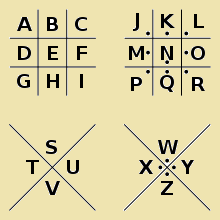
So for A they used __|
B they used |__|
for J __.|
for S \ /
for W \./
It is also named as rosicrucian cipher as it is believed that variations of ciphers was used by Rosicrucians brotherhood along with freemasons.The pigpen cipher is used in Dan brown Novel "The lost symbol".It is also used in the game "Assassins creed II".It was also published in the website The Science of Deduction created by Sherlock series BBC as a part of puzzle.As the cipher is very simple it is also included in children books of ciphers and secret writing.Sometimes It is also called as Tic-tac-toe cipher due to its structures.
Example :
Plaintext : I LOVE THIS BLOG
Ciphertext : ___ __ __ ___ ___ __ ___
| |.__ |.__ /\ | __ | > | | | \/ |___| |.__ |.__ |
PS : The encoding is not very accurate as i used keyboard to write instead of pasting image.
So for A they used __|
B they used |__|
for J __.|
for S \ /
for W \./
It is also named as rosicrucian cipher as it is believed that variations of ciphers was used by Rosicrucians brotherhood along with freemasons.The pigpen cipher is used in Dan brown Novel "The lost symbol".It is also used in the game "Assassins creed II".It was also published in the website The Science of Deduction created by Sherlock series BBC as a part of puzzle.As the cipher is very simple it is also included in children books of ciphers and secret writing.Sometimes It is also called as Tic-tac-toe cipher due to its structures.
Example :
Plaintext : I LOVE THIS BLOG
Ciphertext : ___ __ __ ___ ___ __ ___
| |.__ |.__ /\ | __ | > | | | \/ |___| |.__ |.__ |
PS : The encoding is not very accurate as i used keyboard to write instead of pasting image.
Comments
Post a Comment