
Kakuro Puzzle

Kakuro is second popular puzzle in Japan after sudoku.The kakuro puzzle is played on 16X16 grid of cells which are filled with Black and White respectively.Apart from top row and leftmost column grid is divided into "entries" lines of white cell by the black cells. The black cells contain a diagonal slash from upper-left to lower-right and a number in one or both halves, such that each horizontal entry has a number in the black half-cell to its immediate left and each vertical entry has a number in the black half-cell immediately above it. These numbers are commonly called "clues".
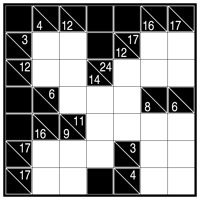


As you can see we have we have horizontal (3) and vertical clue (4).The main objective of Kakuro puzzle is to fill numbers from 1 to 9 in the white cells such that the sum of each horizontal block should be equal to the number on left horizontal clue and sum of each vertical blocks should be equal to the number on top Vertical clue.You cannot use a number more than once in one block for example for the sum to be 3.You cannot use same digits in addition of 3.

The solution of above puzzle 


Karuko puzzles are NP-complete problem.

Comments

Popular posts from this blog

Tricky Questions or Puzzles in C ( Updated for 2026)

Updated for 2026 This article was originally written when C/C++ puzzles were commonly asked in interviews. While such language-specific puzzles are less frequent today, the problem-solving and logical reasoning skills tested here remain highly relevant for modern Software Engineering, Data Engineering, SQL, and system design interviews . Why These Puzzles Still Matter in 2026 Although most Software &   Data Engineering interviews today focus on Programming, SQL, data pipelines, cloud platforms, and system design , interviewers still care deeply about how you think . These puzzles test: Logical reasoning Edge-case handling Understanding of execution flow Ability to reason under pressure The language may change , but the thinking patterns do not . How These Skills Apply to Data Engineering Interviews The same skills tested by C/C++ puzzles appear in modern interviews as: SQL edge cases and NULL handling Data pipeline failure scenarios Incremental vs ...

Decorators in Python

Decorators provide additional functionality to the functions without directly changing their definition of them. Basically, it takes the functions as an argument, adds functionality to them, and returns it.  Before diving deep into the concept of Decorators, let's first try to understand  What are functions in Python and what is an inner function? In Python everything is Objects, be it Class, Variables, and Functions . So functions are python first-class objects that can be used or passed as an argument. You can store the functions in variables, you can pass a function to another function as parameters, and you can also return the function from the function. Below is one simple example where we are treating functions as objects . def make_me_lowercase ( str ): return str .lower() print (make_me_lowercase( "HELLO World" )) copy_of_you = make_me_lowercase print (copy_of_you( "HELLO World" )) The output of the above calls for both the functio...

Program to uncompress a string ie a2b3c4 to aabbbcccc

Below is the program to uncompress a string #include<stdio.h> #include<conio.h> #include<stdlib.h> int main() { char str[100]="a2b3c4d8u7"; for(int i=0;str[i]!='\0';i++) { if(i%2!=0) { for(int j=0;j<atoi(&str[i]);j++) { printf("%c",str[i-1]); } } } getch(); } Want to become a Data Engineer? Check out below blog posts  1.  5 Key Skills Every Data Engineer needs in 2023 2.  How to prepare for Data Engineering Interviews 3.  Top 25 Data Engineer Questions